
What Is Boiúna? Is It Real? The Amazon Legend Behind the Movie
Published · Updated · text produced with AI under human direction and review; quoted passages were checked word for word against the digitized editions cited.
Ler em português · Read in Portuguese · Leer en español
Boiúna is the Cobra Grande, the Great Snake of Amazon folklore: a giant serpent that river people say lives at the bottom of rivers and lakes. The name reads as "black snake". It is a legend, not a known species, written down since 1587. The 2026 film Beware Boiúna is fiction.
Our channel film answers "is the Boiúna real?" with the sources, from 1587 to 1890. Choose the English audio track under Settings, Audio track:
Watch BOIÚNA Existe? Nós Achamos a Resposta on YouTube, on the Águas Profundas channel.
The short answer
The largest real snake of the Amazon is the green anaconda, and travelers in the 1860s already tied the legend to unusually large anacondas. This page is about what the river people told and what writers recorded, from Gabriel Soares de Sousa in 1587 to João Barbosa Rodrigues in 1890, with the year and the author of each version.
Quick facts
- Pronounced
- boy-OO-nah (stress on the "u").
- Also called
- Cobra Grande (Great Snake); boia-açu (Barbosa Rodrigues, 1890); Mai d'agoa or Mother of the Water (Bates, 1863; Smith, 1879).
- Where it is told
- the rivers and lakes of the Brazilian states of Pará and Amazonas: the Rio Negro, the Solimões, Cametá on the Tocantins, Santarém and Belém.
- Oldest written record we checked
- Gabriel Soares de Sousa, Tratado descritivo do Brasil em 1587, which uses the word "Boiuna".
- Real animal
- none of that size has ever been documented. The legend has been documented for more than 400 years.
- The movie
- Beware Boiúna (United States), Boiúna: Terror no Amazonas (Brazil, in cinemas from 12 November 2026), Boiúna: La leyenda del Amazonas (Spain). Fiction.
What does Boiúna mean?
In the Amazon's old lingua franca, the língua geral based on Tupi, boia is snake and una is black, so Boiúna reads as "black snake". The sources show both halves. Barbosa Rodrigues (1890) titles the legend Bóia açu and glosses it as Cobra grande, the Great Snake. Couto de Magalhães (1876) translates ita-una as "black stone", meaning iron: ita is stone, una is black. And the first written description of the Boiuna, in 1587, speaks of a snake covered in black scales. The reading "black snake" is ours, assembled from these three sources; none of the books states it in one sentence.
Is the Boiúna real?
There is no evidence of a snake the size of the legend. What exists, and has been measured, is the anaconda. The English naturalist Henry Walter Bates heard the belief on the Amazon and wrote it down after telling of an anaconda killed on the Cupari River:
The natives of the Amazons country universally believe in the existence of a monster water-serpent, said to be many score fathoms in length and which appears successively in different parts of the river. They call it the Mai d'agoa—the mother, or spirit, of the water.
For Bates, the fable grew out of anacondas of uncommon size. Sixteen years later, Herbert H. Smith, near Santarém, recorded the same belief:
The Indians, almost universally, believe in the existence of an enormous water-serpent, which they call Boia-asu or Mai d'Agua, Mother of the Water.
In 1890, the Brazilian botanist João Barbosa Rodrigues added a footnote that is the closest thing in the old books to an eyewitness claim:
Our translation
Belief would have this serpent be real, its eyes darting light like lighthouses.Original (Portuguese)
A crença quer que seja real a existência d'esse ophidio, cujos olhos dardejam luz como pharóes.
Our translation
one told me that in 1835 it appeared every day below the fort of Belém, another that he saw it on the Purus River. What is remarkable is that both were serious people.Original (Portuguese)
um me disse que em 1835 diariamente apparecia por baixo do forte de Belém, outro que a vio no rio Purús. O que admira é que ambos eram pessoas circumspectas.
He gives no names and no proof. The honest answer: the anaconda is real and has been measured; the Boiúna begins where the measuring tape stopped.
What did the chroniclers actually see?
None of them saw a Boiúna. Each one wrote down what he was told, and only one measured anything.
- Gabriel Soares de Sousa (1587) describes the snake in his chapter on the snakes of Bahia; the story of the swallowed men he credits to the interpreters (línguas) who lived among the Indigenous peoples.
- Henry Walter Bates (1863) saw an anaconda the day after it was killed on the Cupari: 18 feet 9 inches long (about 5.7 m). Later he measured anaconda skins of 21 feet (about 6.4 m). He only heard of 42-foot snakes (about 12.8 m); he never saw one.
- Herbert H. Smith (1879) heard fishermen near Santarém blame the Boia-asu for lakes that appear and dry up.
- João Barbosa Rodrigues (1890) heard two men who said they had seen it, one below the fort of Belém in 1835, one on the Purus.
I saw it the day after it was killed; it was not a very large specimen, measuring only eighteen feet nine inches in length, and sixteen inches in circumference at the widest part of the body.
Are the Boiúna and the Cobra Grande the same?
Yes. In Pará and Amazonas, Boiúna and Cobra Grande name the same creature. Nineteenth-century writers prefer Cobra Grande, Bóia açu or Mãe d'água (Mother of the Water); the word Boiuna is already in Soares de Sousa in 1587. Our longer Portuguese guide to the Cobra Grande has every version.
The Boiúna attack: what the 1587 record says
The only "attack" in the old books is the 1587 one. Soares de Sousa describes a snake that swallows a person whole and then goes into the water to drown its prey. The same chapter tells the way out: men who were swallowed killed the snake from inside with the knife they wore around the neck. That part he credits to the interpreters, not to anything he saw.
What the river people tell
The versions change from river to river, and none of them is the "right" one.
- The snake that swallows people (1587). Soares de Sousa describes the Boiuna as a kind of snake bred in the water and the rivers of the backlands of Bahia, enormous, full of black scales, with a throat wide enough to swallow a person whole; after swallowing, it goes into the water to drown its prey. Interpreters told him that some men, once swallowed, killed the snake from inside with the knife they carried hung around the neck.
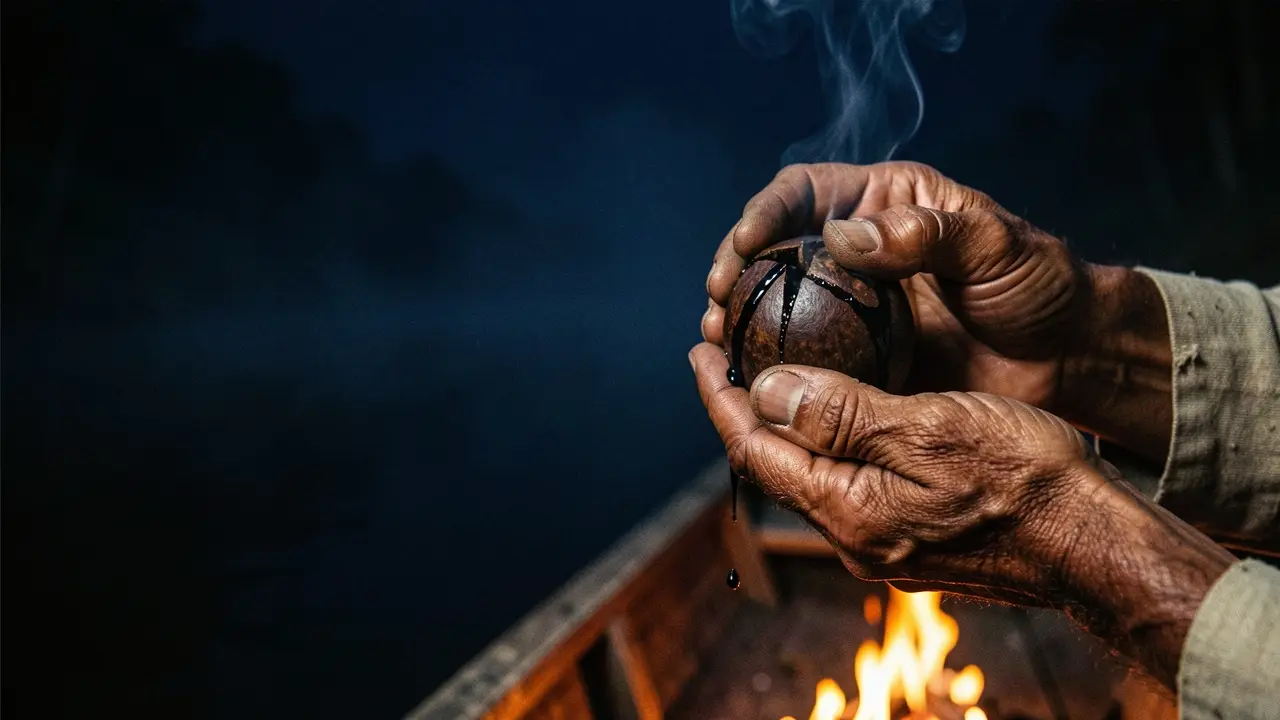
- The keeper of the night (1876). In the Tupi legend Como a noite apareceu (How Night Came to Be), recorded by Couto de Magalhães, there was only day. Night slept at the bottom of the waters, in the Great Snake's house. Three servants were sent for it, received a tucumã palm nut sealed shut, and opened it too soon; everything scattered in the forest and on the river turned into animals.
- Honorato of Cametá (1876). Couto records that the Indigenous people of Cametá, on the Tocantins, attributed to a man named Honorato the power to turn into a fish or a snake and travel along the bottom of the rivers.
- The Great Snake that rose to the sky (1890). On the Rio Negro and the Solimões, the snake loses its mother, finds no place in the river and becomes a constellation. A footnote by Barbosa Rodrigues says it appears in the Amazon sky in September and announces the dry season.
- The snake under Belém (oral tradition). Today people say a snake sleeps beneath the city of Belém and that the city will sink if it wakes. We did not find this version in the public-domain books we read, so we treat it as oral tradition.
Whose stories are these: Indigenous and riverside narrators of Pará and Amazonas, telling them in the língua geral. They were written down by Couto de Magalhães (1876) and Barbosa Rodrigues (1890).
The legend vs. the movie: why the film doesn't show this
By the distributor's synopsis, the 2026 film is a creature-horror fiction about a giant snake. This page does not summarize, review or predict it. What the books hold, and a monster movie has little room for:
- In the books, the Great Snake is rarely just a monster that hunts. It keeps the night, looks for its mother, becomes a constellation and announces the dry season.
- The snake that swallows people is in the sources, but it is the 1587 one, and the same account tells how a swallowed man got out: with his knife, from inside.
- In the Amazon versions, people who meet the Great Snake often speak to it. A lost hunter on the Solimões calls it grandfather.
Watch: the Great Snake on our channel
Our sister channel in Portuguese, Águas Profundas, has two long films with English audio tracks (Settings, Audio track): the one at the top of this page, Is the Boiúna real?, and the Rio Negro version, the mother hidden in a clay pot.
Short versions: the night the Great Snake kept inside a nut (1876) and the Great Snake that ordered a hunter out of a hollow tree (1890).
Frequently asked questions
What is Boiúna? The Great Snake of Amazon folklore, a giant serpent believed to live at the bottom of rivers and lakes in northern Brazil. It appears in writing from 1587.
Is Boiúna a real snake? No snake of that size has been documented. The largest real snake of the Amazon is the green anaconda, and Bates (1863) explained the belief by unusually large anacondas.
What does Boiúna mean in English? It reads as "black snake": in the Amazon's Tupi-based lingua franca, boia is snake and una is black. The earliest description, from 1587, mentions black scales.
Is Beware Boiúna based on a true story? No. The film is fiction. What has a documentary basis is the legend, recorded by Soares de Sousa, Bates, Couto de Magalhães, Smith and Barbosa Rodrigues.
Is the Boiúna the same as the Cobra Grande? Yes, in the tradition of Pará and Amazonas. Nineteenth-century writers prefer Cobra Grande, Bóia açu or Mother of the Water; the word Boiuna is already in Soares de Sousa in 1587.
Did anyone ever see the Boiúna? Not in any record we checked. Bates (1863) measured anacondas of up to 21 feet; Barbosa Rodrigues (1890) wrote down two men who said they had seen the Great Snake, without names or proof.
What is the Boiúna attack? In the 1587 record, the Boiuna swallows a person whole and goes into the water to drown them; the same text says swallowed men killed it from inside with a knife.
How do you pronounce Boiúna? Boy-OO-nah, with the stress on the "u".
What is the oldest source on the Boiúna? Gabriel Soares de Sousa's Tratado descritivo do Brasil em 1587, in the chapter on the great snakes of the rivers of Bahia.
One account at a time
Further reading
The Naturalist on the River Amazons
Henry Walter Bates (1863)
Chapter IX: after an anaconda is killed on the Cupari, Bates records the belief in the Mai d'agoa, the monster water-serpent, and explains it by unusually large anacondas. In English.
Brazil, the Amazons and the Coast
Herbert H. Smith (1879)
Page 560, written near Santarém: the Boia-asu, Mother of the Water, blamed by fishermen for lakes that appear and vanish. In English.
Poranduba Amazonense
João Barbosa Rodrigues (1890)
Two versions of the Great Snake that rose to the sky, recorded in the Amazon's lingua franca with a Portuguese translation, and a footnote on two men who said they saw it. In Portuguese.
O Selvagem
Couto de Magalhães (1876)
The Tupi legend in which night sleeps at the bottom of the waters, in the Great Snake's house. In Portuguese.
Cite this page
Vigil Page. "What Is Boiúna? Is It Real? The Amazon Legend Behind the Movie." Published 10 November 2026, updated 12 November 2026. https://vigilpage.com/legends/boiuna/
Revision history
- : First publication.
- : Direct answer under the title; new sections on the Cobra Grande, the 1587 attack and what the chroniclers actually saw; the channel film embedded; link to the Portuguese version.
- : New channel film (English audio track) embedded under the answer; Spanish version linked.
Read next
- The Boitatá: Brazil's other snake, the one made of fire.
- The Curupira: the forest guardian, from the same 1890 book.
- All legends, with sources
- In Portuguese: O que é a Boiúna? and the longer guide to the Cobra Grande
Sources
- Gabriel Soares de Sousa, Tratado descritivo do Brasil em 1587 (Varnhagen edition, 1851), the chapter on great river snakes: read free. Paraphrased only; the scan is noisy.
- Henry Walter Bates, The Naturalist on the River Amazons (London, 1863), chapter IX: read free.
- Couto de Magalhães, O Selvagem (Rio de Janeiro, 1876), "Como a noite apareceu", the Tupi names of metals and "Família e religião selvagem": read free. English summaries are ours.
- Herbert H. Smith, Brazil, the Amazons and the Coast (New York, 1879), p. 560: read free.
- João Barbosa Rodrigues, Poranduba Amazonense (Rio de Janeiro, 1890), "Bóia açu", "Bóia uaçu" and the footnotes on pp. 233 and 242: read free. Translations ours.
- All digitized editions above were consulted on 10 November 2026. Film titles and the Brazilian release date (12 November 2026): distributor announcements, checked on 10 November 2026.