
The Strait of Malacca explained: why China fears it
Published · text drafted with AI assistance from the primary sources cited on the page, then checked against them and by an independent panel of AI models; every figure is attributed.
The Strait of Malacca (also called the Malacca Strait) is the narrow sea lane between Sumatra and the Malay Peninsula that connects the Indian Ocean with the South China Sea. The U.S. EIA calls it the largest oil chokepoint in the world by transit volume, and it is the core of China's "Malacca dilemma".
The short answer
The U.S. Energy Information Administration (EIA) calls the Strait of Malacca "the largest chokepoint in the world in terms of oil transit volume": 24.0 million barrels per day in 2023, 22.5 million in 2024 and 23.2 million in the first half of 2025, which the EIA puts at 29% of all maritime oil flows in that half-year. UNCTAD puts it at 23.7% of global seaborne trade volume (2023). At its narrowest, in the Phillips Channel of the Singapore Strait, it is only about 1.7 miles (2.7 km) wide (EIA, 2017). China's leadership has treated outside control of it as a strategic concern since at least November 2003 (Storey, 2006).
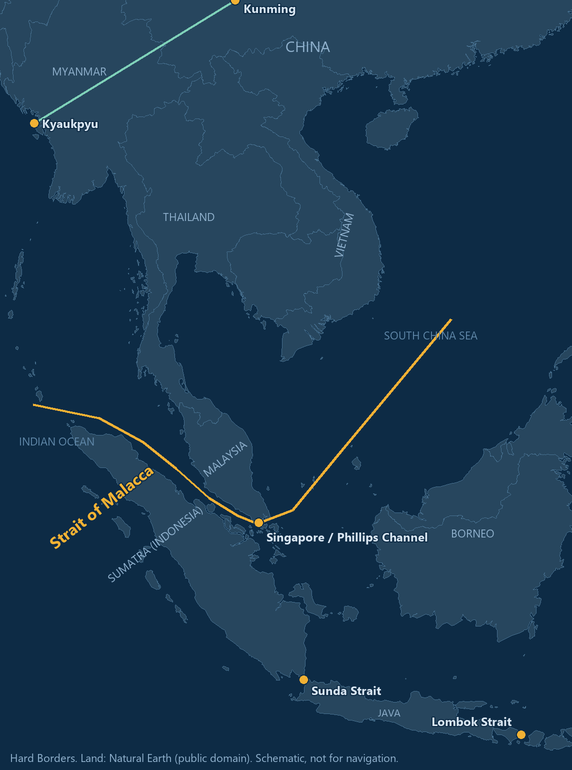
What is the Strait of Malacca?
The Strait of Malacca links the Indian Ocean and the Pacific Ocean. The EIA describes it as "the shortest sea route between Middle East oil and natural gas suppliers and growing markets in East and Southeast Asia", flowing between Indonesia, Malaysia and Singapore. At the southern end it runs into the Singapore Strait and then the South China Sea. Because ships in the Strait of Malacca and the Singapore Strait use one connected route, people often use "Strait of Malacca" for the whole corridor.
How narrow is the Strait of Malacca?
The EIA states that "at its narrowest point in the Phillips Channel of the Singapore Strait" the strait is "only about 1.7 miles wide" (August 11, 2017). That is about 2.7 km (our conversion), or roughly 1.5 nautical miles, the unit some sources use for the same pinch. This is why the strait is called a chokepoint: a very large volume of traffic is squeezed through a lane a few kilometres across.
How much oil passes through the Strait of Malacca?
The EIA publishes yearly flows through every major oil chokepoint. For Malacca, crude oil makes up slightly more than 70% of total oil flows each year and petroleum products the rest. In 2024 flows fell because of OPEC+ production cuts, then rose again in the first half of 2025.
| 2020 | 2021 | 2022 | 2023 | 2024 | 1H25 | |
|---|---|---|---|---|---|---|
| Total oil through Malacca | 22.8 | 22.1 | 23.0 | 24.0 | 22.5 | 23.2 |
| Crude oil and condensate | 16.4 | 15.4 | 16.3 | 17.1 | 15.9 | 16.6 |
| Petroleum products | 6.4 | 6.6 | 6.7 | 6.9 | 6.6 | 6.5 |
| LNG (Bcf/d) | 7.4 | 8.9 | 8.3 | 9.4 | 10.1 | 9.2 |
| Strait of Hormuz, total oil | 19.2 | 19.7 | 21.9 | 21.8 | 20.7 | 20.9 |
| World maritime oil trade | 74.1 | 75.9 | 78.6 | 80.2 | 79.7 | 79.8 |
| Malacca as % of world maritime oil trade (calculated) | 30.8% | 29.1% | 29.3% | 29.9% | 28.2% | 29.1% |
Million barrels per day (LNG: billion cubic feet per day). 1H25 = first half of 2025. Source: U.S. EIA, World Oil Transit Chokepoints, Tables 1 and 2. The last row is our own division of EIA's two rows.
Malacca carries more oil than the Strait of Hormuz in every year of the EIA table. Nearly 60% of the crude oil going through Malacca in the first half of 2025 came from four Persian Gulf OPEC producers (Saudi Arabia, the United Arab Emirates, Kuwait and Iraq). In the same period about 9.2 billion cubic feet per day of liquefied natural gas also passed through.
What share of world trade uses the Strait of Malacca?
UNCTAD's Review of Maritime Transport 2024, titled "Navigating maritime chokepoints", lists the Strait of Malacca at 23.7 per cent of global seaborne trade volume in 2023 (Table I.8). It also gives the share of individual commodities that move through the strait: crude oil 45 per cent, propane 42 per cent, cars 26 per cent and dry bulk 23 per cent. The strait therefore matters for manufactured goods and bulk cargo as well as for oil.
Why does China fear the Strait of Malacca?
China is the world's largest crude oil importer, bringing in 11.3 million barrels per day in 2023 and 11.1 million in 2024 (EIA). The EIA reports that China accounted for 48% of the import volumes passing through the Strait of Malacca in the first half of 2025, and that most crude traversing the strait goes from the Middle East to East Asia. A route that central to Chinese energy supply passes through the waters of Indonesia, Malaysia and Singapore, none of which is China. Chinese strategists call this exposure the Malacca dilemma.
The Jamestown Foundation analyst Ian Storey wrote in 2006 that "in November 2003 President Hu Jintao declared that 'certain major powers' were bent on controlling the strait". Storey adds that Hu urged new approaches to reduce the perceived vulnerability. The EIA lists a China-Myanmar oil pipeline among the alternatives to the strait.
Can ships or pipelines bypass the Strait of Malacca?
The EIA names the alternatives to the Strait of Malacca:
- the Sunda Strait and the Lombok Strait, two smaller chokepoints in the Indonesian archipelago;
- a longer route around the entire archipelago;
- an oil pipeline from Myanmar to south-west China, which carries Middle Eastern crude landed on the Indian Ocean coast (the Kyaukpyu to Kunming line on the map above).
On the EIA's numbers, none of these is a replacement at the scale of the strait: Malacca carried 22.5 million barrels per day in 2024, more than any other chokepoint in the EIA table. The Sunda and Lombok routes run through the same Indonesian archipelago and add sailing distance, and the pipeline ends in south-west China, far from the coast. The EIA's China analysis names the China-Myanmar, Kazakhstan-China and ESPO pipelines but gives no capacity figures, so this page does not quote any.
What are the risks in the Strait of Malacca?
The EIA cites the International Maritime Bureau's Piracy Reporting Centre: piracy, including attempted theft and hijackings, is a threat to tankers in the Strait of Malacca, and attacks on ships increased after 2023, especially around Singapore. Beyond piracy, the concern in the "Malacca dilemma" is strategic: a disruption of a lane that carries 23.7% of world seaborne trade volume would be felt well beyond Asia.
Who governs the Strait of Malacca?
The strait is bordered by Indonesia, Malaysia and Singapore. Under Part III of the UN Convention on the Law of the Sea, ships of all states have the right of transit passage through straits used for international navigation, which limits what the coastal states can do to passing traffic.
Strait of Malacca: frequently asked questions
Where is the Strait of Malacca? It is the sea lane between the Indonesian island of Sumatra and the Malay Peninsula (Malaysia), running south-east to Singapore. The U.S. EIA says it "flows between Indonesia, Malaysia, and Singapore" and connects the Indian Ocean with the Pacific Ocean through the South China Sea (https://www.eia.gov/todayinenergy/detail.php?id=32452). It is also written "Malacca Strait" or "Straits of Malacca".
How wide is the Strait of Malacca at its narrowest? The U.S. EIA gives "only about 1.7 miles wide" at its narrowest point, in the Phillips Channel of the Singapore Strait (Today in Energy, August 11, 2017). That is about 2.7 km (our conversion). Some sources give roughly 1.5 nautical miles, which is the same distance in different units.
How much oil passes through the Strait of Malacca? According to the U.S. EIA, 24.0 million barrels per day of crude oil and petroleum products passed through in 2023 and 22.5 million in 2024, and 23.2 million in the first half of 2025, which the EIA describes as equivalent to 29% of total maritime oil flows. The EIA calls it the largest chokepoint in the world in terms of oil transit volume.
What share of world trade passes through the Strait of Malacca? UNCTAD's Review of Maritime Transport 2024 (Table I.8) puts the Strait of Malacca at 23.7 per cent of global seaborne trade volume in 2023. By commodity, it lists crude oil (45 per cent), propane (42 per cent), cars (26 per cent) and dry bulk (23 per cent).
What is the Malacca dilemma? It is the name given to China's strategic vulnerability: a large share of its imported oil must pass a narrow waterway that it does not control. Ian Storey (Jamestown Foundation, 2006) writes that in November 2003 President Hu Jintao "declared that 'certain major powers' were bent on controlling the strait". See the dedicated page on the Malacca dilemma.
How much of China's oil goes through the Strait of Malacca? No official source we found publishes one audited share. Figures such as "about 80%" circulate in commentary; they depend on the year and the method, and none appears in the EIA chokepoint page. What the EIA does publish is the other side of the ratio: China accounted for 48% of the import volumes passing through the strait in the first half of 2025. For scale, the EIA puts China's crude oil imports at 11.3 million barrels per day in 2023 and 11.1 million in 2024.
Can China bypass the Strait of Malacca? Only partly. The EIA lists the alternatives: the Sunda Strait and the Lombok Strait in the Indonesian archipelago, a longer route around the whole archipelago, and an oil pipeline that carries Middle Eastern crude from Myanmar to south-west China. Each of those either adds distance or reaches only part of China. The EIA's chokepoint tables show Malacca at 22.5 million barrels per day in 2024, ahead of every other chokepoint in the table, including Hormuz at 20.7.
Is the Strait of Malacca busier than the Strait of Hormuz? For oil, yes. The EIA reports 22.5 million barrels per day through Malacca in 2024 against 20.7 million through Hormuz, and 23.2 against 20.9 in the first half of 2025. The two straits differ in what they carry: Hormuz is the exit of the Persian Gulf, while Malacca carries Gulf oil onward to East Asia along with a large share of general cargo.
Who controls the Strait of Malacca? It is bordered by Indonesia, Malaysia and Singapore, which hold sovereignty over the surrounding waters. Under Part III of the UN Convention on the Law of the Sea, ships of all states have the right of transit passage through straits used for international navigation (Article 38), so the coastal states cannot simply close it to passing ships.
Sources
- U.S. Energy Information Administration (EIA), World Oil Transit Chokepoints (last updated March 3, 2026)
- U.S. EIA, Today in Energy: The Strait of Malacca, a key oil trade chokepoint, links the Indian and Pacific Oceans (August 11, 2017)
- U.S. EIA, China country analysis (last updated May 19, 2025)
- UNCTAD, Review of Maritime Transport 2024: Navigating maritime chokepoints, Table I.8
- Ian Storey, China's "Malacca Dilemma", China Brief vol. 6 no. 8, The Jamestown Foundation (April 12, 2006)
- United Nations Convention on the Law of the Sea, Part III: Straits used for international navigation
Figures were read directly from these documents on 2026-11-27. The EIA page is updated periodically, so later editions may show revised numbers. See sources and corrections for how we treat figures that differ between sources.